
What is creativity? How can we nurture it? Why should we?

Creativity is not just about being able to create a pretty picture… it is the interest in discovery, being open to new ideas, showing imagination and purpose, challenging, questioning, reflecting critically. Being creative improves a child’s self-esteem, motivation and achievement. But a teacher being creative will not necessarily help a child be creative!
Read more in this short engaging article about the What, Why & How of creativity here…
________________________________________________________
Art enables pupils to understand, appreciate and contribute
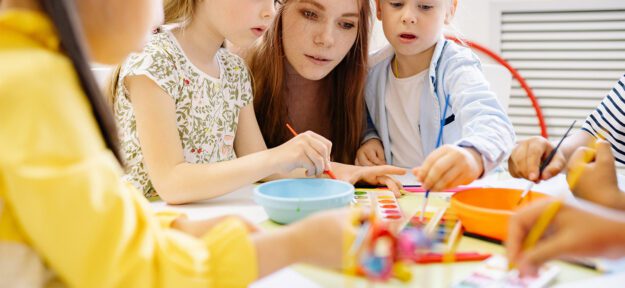
Arts education fosters a life-long interest in culture, improves academic performance and creates career opportunities.
The study of art enables pupils to understand, appreciate and contribute to a dimension of life that expresses human innovation, imagination and thought, in a way that A.I. cannot.
Step into a classroom where arts-based learning brings lessons to life and children are fully engaged… Read about the benefits of Arts-based learning in Primary education here
________________________________________________________
Childhood is tough in this decade & mental health is in decline
Not only is art, drama and music disappearing from children’s timetables, post-Covid many children are experiencing mental health issues and schools report increased absenteeism. Evidence shows engagement with the arts improves mental health and well-being as well as academic attainment. (Fancourt et al., 2020; Golden et al., 2024; How Arts Can Help Improve Your Mental Health, n.d.)
“The best, most effective and proven way to allow a young person to become who they are meant to be is to allow them to explore, experience, play, experiment, think and fail. With music, drama, painting, creative writing, debating and any creative endeavour, a child will be fed with the best that humanity has to offer.
If they have nowhere to escape from their hardships or if they have no sensory experience apart from their screens, they will turn in on themselves with inadequate maturity to get out of the darkness.”
Art, music and drama, in all its wonder, can be an answer. It provides companionship, community, goals, success, resilience, teamwork, leadership, fun, laughter, challenge, and connection. It provides an antidote to pale, sad faces and for the young people with nothing to do and nowhere to go. Instead of the drudgery of hopelessness, the hands-on experience of different branches of the arts provide hope. And hope is the greatest medicine with which to battle the very real horrors of mental illness.
Read the full statement by Julie Lynn-Evans, child psychotherapist and adviser to CATS here
________________________________________________________
Researching Arts in Primary Schools, Pat Thomson
The RAPS (Researching Arts in Primary Schools) Project investigated arts-rich schools, asking what arts richness is, how it is achieved and what are the benefits. The University of Nottingham study, funded by the Freelands Foundation, examined 76 schools through surveys and focused on 40 for detailed case studies, with particular attention to 22 schools for in-depth analysis.
Schools reported multiple benefits from arts richness: enhanced student engagement and wellbeing; development of creativity and self-expression; stronger community connections; improved staff retention; and support for learning across the curriculum.
The study found that 77% of RAPS schools performed as well as or better than comparable schools on standard measures, with 60% exceeding their local authority average. Rich arts provision was reflected in strong inspection ratings. This key RAPS finding challenges the notion that prioritising arts education undermines academic achievement
Read more about the full RAPS report here
________________________________________________________
Creativity, Engineering & Technology
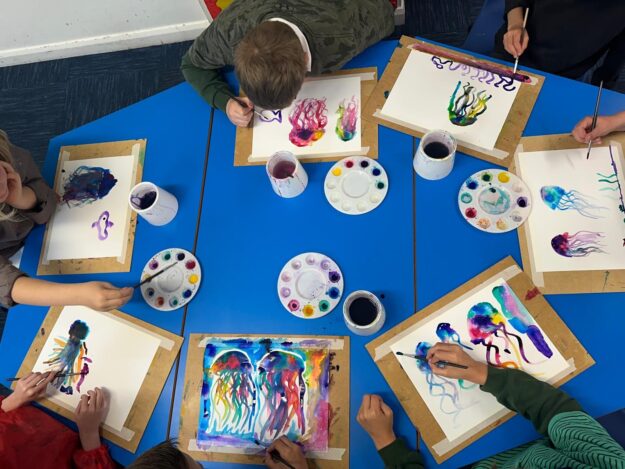
Developing the arts in schools is not just about creating future artists and musicians for careers or just an informed interest in the arts – important though that is (the arts account for 3-5% of the UK’s GDP, depending on whose analysis you are looking at). Stimulating creativity is also key to the education of children – it is lighting a spark of curiosity and enthusiasm. As AI renders many white collar jobs redundant, primary school children today need to be stimulated and creative if they are to be able to do tomorrow’s jobs better than AI.
There are many careers that benefit from incorporating the arts in to school life:
Creative and Cultural Industries
- Musicians, actors, dancers, artists, writers, designers, directors, producers
→ Directly rely on artistic skills and creative expression.
Media, Communication & Technology
- Game designers, animators, filmmakers, advertisers, content creators, UX/UI designers
→ Need imagination, storytelling, visual literacy, and performance awareness.
Education & Training
- Teachers, early years practitioners, speech and drama coaches, special needs educators
→ Benefit from oracy, drama, and music in engaging and supporting diverse learners.
Healthcare & Wellbeing
- Art therapists, music therapists, drama therapists, occupational therapists, child psychologists
→ Use arts as tools for healing, communication, and emotional expression.
Business & Leadership
- Entrepreneurs, managers, negotiators, public speakers, politicians, sales people
→ Rely on oracy, creativity, and performance skills to persuade, lead, and innovate.
STEM with Creativity
- Architects, product designers, engineers, innovators, researchers
→ Use design thinking, imagination, and presentation skills to bring new ideas to life. Without art skills how can engineers visualise systems or sketch their ideas?
Community & Social Change
- Activists, social workers, community organizers, cultural policymakers
→ Need strong oracy, drama, and storytelling to inspire, connect, and lead change.
Careers of the future will demand adaptability, creativity, and communication – all cultivated more effectively through an education enriched with the arts. Without them, students risk being less prepared for roles requiring empathy, collaboration, and innovation.
Read more about Creativity, Engineering, and Technology here
________________________________________________________
Academic Studies
A number of reports examine & define the clear correlation between art education and improved academic achievement, suggesting that art activities enhance problem-solving and other general academic abilities.
Read more about these reports here
________________________________________________________
Arts Council with Arts Award
The Arts Council says “Schools that integrate arts across the curriculum… have shown consistently higher average reading and mathematics scores compared to similar schools that do not.” The arts are also a vital part of a whole school ethos of cultural appreciation and diversity, equipping students with cultural knowledge and understanding that will enable them to make better sense of the world and their place within it.
Read more about the evidence & impact of arts award here
________________________________________________________
OFSTED Research Review Series: Art & Design, report Feb 2023
“The study of art enables pupils to understand, appreciate and contribute to a dimension of life that taps into and expresses human innovation, imagination and thought.
At an individual level, a high-quality art education can build pupils’ ability to ‘appreciate and interpret what they observe, communicate what they think and feel, or make what they imagine and invent. At its best, the subject is both intellectually challenging and creatively demanding.
This review explores some factors that contribute to a high-quality art education.”
Read more about the report here
Read the full research and analysis here
________________________________________________________
In 2020 the Royal Society of Arts (RSA) publish their ‘Arts-rich Schools’ report
Their assessment covers eight case studies of schools with whole-school, arts-based approaches. Key recommendations started with:
1. Schools should maintain an arts-rich curriculum. Teaching through the arts can support children’s academic progress (p27)
Read more excerpts of the study here
________________________________________________________
The power of music to change lives: a national plan for music education
This policy paper sets out the previous governments vision for music education and how this can be achieved through partnerships with schools, music hubs, the music and creative sector, and others.
Published by Department of Culture Media & Sport, June 2022
________________________________________________________
Areas of high deprivation in the UK IMD
A nationwide problem is that children from more disadvantaged backgrounds are less able to be involved in the arts. Many young people only take part in cultural learning activities such as music and theatre during school hours, but funding and skills cuts have significantly reduced these opportunities
The Social Mobility Commission and the Sutton Trust have found that children from disadvantaged backgrounds are less likely to take part in extra-curricular arts activities. In 2017, the RSA launched ‘Learning About Culture’, the UK’s largest ever study into understanding the value and impact of arts-based learning, particularly for children experiencing deprivation. The evaluators’ report (2021) stated that school leaders spoke about an improvement in exam results or Ofsted outcomes that they attributed to their school’s commitment to the arts. Staff and students consistently cited the benefit of personal development, increased confidence, and improved motivation at school.
Areas of deprivation in the Cotswolds region
There are three wards defined as ‘deprived’ in Banbury, and we are in discussions with the local authority there, Cherwell Council, to work in nine of the schools in that area on a match funding basis. In Chipping Norton there is one very deprived ward and we have been operating in the two schools there for two years and six years respectively.
________________________________________________________
Bridging the Gap
The work CATS does addresses significant gaps in state Arts education whilst improving the emotional health, well-being, skills and prospects of children. We serve a predominantly rural area which has pockets of multiple deprivation in both villages and towns.
Since our launch in 2023 we’ve been able to make a positive impact in the lives of thousands of school children through our engaging arts workshops and experiences in a variety of art, music, dance and drama programmes. We are inspiring children to develop their creative potential, improving their self-confidence and bring about positive change within their school environment.
Music
OFSTED says every primary school should have daily singing and provide opportunities for learning instruments. But according to our research this is not happening in most schools in our area, primarily due to a lack of suitable staff. Most Primary schools now have almost no musical activity in school time and minimal opportunity out of hours.
The UK Government policy on funding Arts is long in ambition. In relation to music it’s set out in: The power of music to change lives – A National Plan for Music Education.
“All children, regardless of background, should have access to a high-quality music education, should understand their options, and be supported to make progress.”
Learning about music and having the opportunity to play musical instruments and make music together is a vital part of a rich and rounded education (OFSTED). It has also been proven that music plays a key role in brain development. It helps with the nurturing of language, maths, motor skills, emotional intelligence, and collaboration skills.
The experience of Leicestershire’s £1 a lesson programme a few years ago can now be seen in the number and quality of students playing in Conservatoires.
In this country, schools doing the intense arts enrichment programme MSST (Music in Secondary Schools Trust) report GCSE results that are overall twice as good as similar schools not in the MSST group.
Art
In February 2023 the government published a review of the research about the impact of art and design in which it said a high-quality art education can build pupils’ ability to “appreciate and interpret what they observe, communicate what they think and feel, or make what they imagine and invent.”
The Arts Council says:
“Schools that integrate arts across the curriculum… have shown consistently higher average reading and mathematics scores compared to similar schools that do not.”
According to Ofsted (2023) the study of art enables pupils to understand, appreciate and contribute to a dimension of life that taps into and expresses human innovation, imagination and thought.
Oracy
Oracy is to speaking what numeracy is to mathematics or literacy to reading and writing. In short, it’s nothing more than being able to speak and listen well across a range of contexts. Children need to be able to speak well if they are to make presentations, stand-up for their rights, or express their feelings. A.I. means many schools in the future will be wary of written work and will want a greater emphasis on verbal presentations to ensure the child understands what they have been taught. Many pupils coming through our state primary schools lack basic speaking skills. There are well established programmes with London Academy of Music and Dance, the English Speaking Union and English Speaking Board to help develop oracy (speaking) skills but no allocated school time and often there is no teacher qualified to lead an initiative. CATS will provide this with our partners.