
A very musical family of nine – meet the Kanneh-Mason’s
Meet Stuart & Kadiatu Kanneh-Mason and their family: seven children between 15 and 28 who have become a fixture in British cultural life. Sheku, a cellist and the third eldest, won the BBC young Musician of the Year award in 2016, performed at Prince Harry’s wedding and starred at the Last Night of The Proms last summer. This summer, Isata, the eldest will perform Clara Schumann’s piano concerto at the First Night of the Proms. Sheku and his brother Braimah will play a mid-season Prom with the Fantasia Orchestra. Three have contracts with major record labels and Sheku’s recent Beethoven album topped the classical charts.
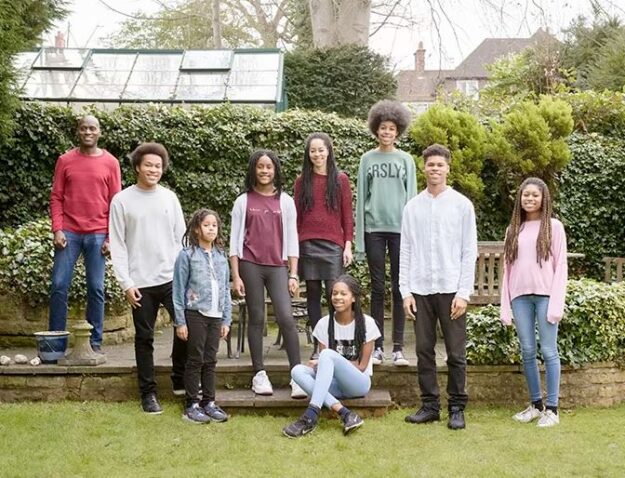
the Kanneh-Mason family
Times journalist Neil Fisher talked to mum of seven, Kadiatu Kanneh-Mason at Ashmole Primary School near the Oval cricket ground in south London. This small, “Outstanding” school looks like a brilliant advert for a rounded state education. As the Ofsted report puts it; “All pupils learn to play musical instruments from a young age. Many go on to play these to a highly competent level.”
Yet this is only because the independent charity London Music Matters (LMM), of which Kadiatu is a trustee, has embedded its teachers and lessons into the working week, with minimal cost to the school. She and I have spent the afternoon watching 7 to 11 year old string players performing with LMM teachers, showing remarkable dedication. Half the children in this age group choose to play in the school orchestra.
LMM is undoubtedly transforming lives, yet it can work with only a handful of schools in the capital. And without the sticking plaster of such philanthropic initiatives, music education in state schools – including the one that all seven Kanneh-Mason siblings attended – is withering to extinction. “Things have got worse and it’s a tragedy.”
Astonishingly the rot set in just as cellist Sheku was lifting his BBC trophy. “The term he won, there was a change of head teacher. It became a multi-academy trust, and the new head teacher didn’t like music; Sheku won BBC Young Musician – and he axed the cello teacher.” Sheku donated his £3,000 prize money to his school so that it could continue to have a teacher, which lasted three years. “Paltry,” she agrees – not for her son, but in the context of the school budget.
But it’s not about pumping out prodigies, future Kanneh-Masons. “I didn’t expect all my children to become musicians, that wasn’t the point. It’s bigger than that. It’s about confidence, about being able to achieve across subjects. If you have strong music in school, you also have children who believe in themselves and believe in each other.
I ask her if she thinks the Kanneh-Mason family story would have been different if she was starting out now. “It would be even harder”. In her book House of Music Kadiatu writes potently about growing up in the UK in the seventies, experiencing both casual and aggressive racism. The world of classical music was not a place where she encountered this, however – nor did her husband, Stuart, who grew up in south London with his Antiguan parents listening to classical music. His “Eureka” moment, as Kadiatu calls it in her book, was when the whole family went to see Daniel Barenboim play the complete Chopin Preludes. “Classical music is incredibly inclusive. What makes it exclusive is the lack of music education”.
The gulf between state and private education is emblematic of this. “In fact, the only young black people I know who are studying music to a high standard have got music scholarships to private schools. We could have gone down that path – they [the children] could have got great music scholarships, but we wanted them to live at home, to be able to meet their friends from their own area and their own community. We made that decision – but it’s become an almost impossible decision now if you want to be a classical musician.”
Abridged and extracted from an article published in The Times Arts supplement, Friday July 5th 2024
Author: Neil Fisher


